Gujarat has established itself as one of India’s leading industrial and manufacturing hubs, supported by strong infrastructure, business-friendly policies, skilled manpower, and well-developed supply chains. Among the many industries contributing to the state’s industrial growth, aluminium processing and fabrication have gained significant importance. An Aluminium Extrusion plant in Gujarat plays a crucial role in producing high-quality aluminium profiles and components for industries ranging from construction and automotive to electrical, solar, and engineering applications.
Aluminium extrusion is a manufacturing process in which an aluminium billet is heated and pushed through a specially designed die to create profiles with specific shapes and dimensions. The process allows manufacturers to produce lightweight, durable, and versatile components while maintaining excellent dimensional accuracy. With growing demand for efficient and sustainable materials, aluminium extrusion has become an essential manufacturing solution for modern industries.
Why Gujarat Is Ideal for Aluminium Extrusion Manufacturing
Gujarat offers several advantages for establishing and operating an aluminium extrusion plant. The state has excellent road, rail, and port connectivity, making it easier to transport raw materials and finished aluminium products across India and international markets. Industrial areas in cities such as Ahmedabad, Vadodara, Rajkot, Surat, and other manufacturing centers provide access to established infrastructure and supporting industries.
The availability of skilled and semi-skilled workers is another major advantage. Aluminium extrusion requires technical expertise in areas such as die design, billet heating, extrusion, cooling, cutting, finishing, quality inspection, and packaging. Gujarat’s strong industrial ecosystem helps extrusion manufacturers access the workforce and supporting services required for efficient production.
Advanced Aluminium Extrusion Processes
A modern Aluminium Extrusion plant in Gujarat typically incorporates advanced machinery and quality-control systems to manufacture profiles according to specific customer requirements. The production process generally starts with selecting suitable aluminium alloys based on the intended application.
The aluminium billets are heated to the required temperature before being pushed through an extrusion die. Once the profile emerges, it is cooled and cut into required lengths. Further processes such as ageing, anodizing, powder coating, polishing, or other surface treatments can be carried out depending on the product specification.
Modern extrusion plants also use precision measuring equipment to maintain dimensional consistency. Strict quality checks throughout production help ensure that the finished profiles meet industry standards and customer specifications.
Applications of Aluminium Extruded Profiles
Aluminium extruded products are used across numerous industries because of their combination of strength, low weight, corrosion resistance, and design flexibility. In the construction sector, aluminium profiles are commonly used for doors, windows, curtain walls, partitions, railings, and structural applications.
The automotive industry uses aluminium extrusion for lightweight components that can contribute to improved vehicle efficiency. Electrical and electronics manufacturers use aluminium profiles for enclosures, heat sinks, frames, and other components where effective heat dissipation and durability are important.
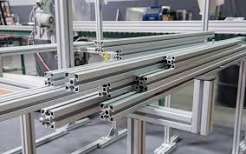
The renewable energy sector is also creating new opportunities for aluminium extrusion. Solar panel mounting structures and support systems frequently use aluminium because it is lightweight, corrosion-resistant, and suitable for outdoor environments. Industrial machinery, furniture, transportation, and engineering applications further expand the demand for extruded aluminium profiles.
Benefits of Choosing Aluminium Extrusion
One of the key advantages of aluminium extrusion is design flexibility. Manufacturers can create complex cross-sectional shapes that may be difficult or expensive to produce using other manufacturing techniques. This flexibility allows businesses to develop customized profiles for specific applications.
Aluminium also offers an excellent strength-to-weight ratio. Its lightweight nature can help reduce transportation and installation costs while providing reliable performance. In addition, aluminium naturally forms a protective oxide layer that helps improve corrosion resistance.
Another important benefit is recyclability. Aluminium can be recycled repeatedly without losing its fundamental properties, making it an attractive material for companies focusing on sustainable manufacturing and environmentally responsible product development.
Choosing the Right Aluminium Extrusion Plant
Businesses looking for aluminium extrusion products should consider several factors when selecting a manufacturing partner. Production capacity, alloy availability, profile size capabilities, dimensional accuracy, surface finishing options, quality-control procedures, customization capabilities, and delivery timelines are important considerations.
A reliable Aluminium Extrusion plant in Gujarat should also have experienced technical professionals, modern extrusion equipment, efficient quality-assurance systems, and the ability to handle both standard and customized requirements. Consistent product quality and dependable customer service can help businesses establish long-term supply relationships.
Future of Aluminium Extrusion in Gujarat
With increasing urbanization, infrastructure development, automotive manufacturing, renewable energy projects, and industrial automation, demand for aluminium profiles is expected to continue growing. Gujarat’s established industrial ecosystem positions it strongly to serve both domestic and export markets.
As manufacturers adopt automation, energy-efficient production methods, advanced finishing technologies, and improved quality-control systems, aluminium extrusion plants can become even more efficient and competitive. The combination of Gujarat’s industrial advantages and aluminium’s versatile properties makes extrusion an important part of India’s manufacturing future.
In conclusion, an Aluminium Extrusion plant in Gujarat serves as an important link between raw aluminium and high-performance components used across multiple industries. With advanced production capabilities, skilled professionals, customization options, and strong logistics infrastructure, Gujarat continues to offer an excellent environment for aluminium extrusion manufacturing and long-term industrial growth.


